
The first hurdle. The infamous flight into Lukla’s Tenzin-Hillary Airport.
Pat (my hiking partner and childhood buddy) and I had been enjoying the food, culture, cheap beers and hustle of Kathmandu for the last few days, but there was undoubtedly an elephant in the room. For those that are unaware, the flight to start the EBC trek begins and ends with a flight like no other in the world. At an elevation of 2845 m above sea level, a length of 526m, grade of nearly 12%, the pilots have zero bailout option once they commit to their landing, with steep cliffs surrounding all sides. There is a reason why this airport is labelled as one of the most dangerous in the world.
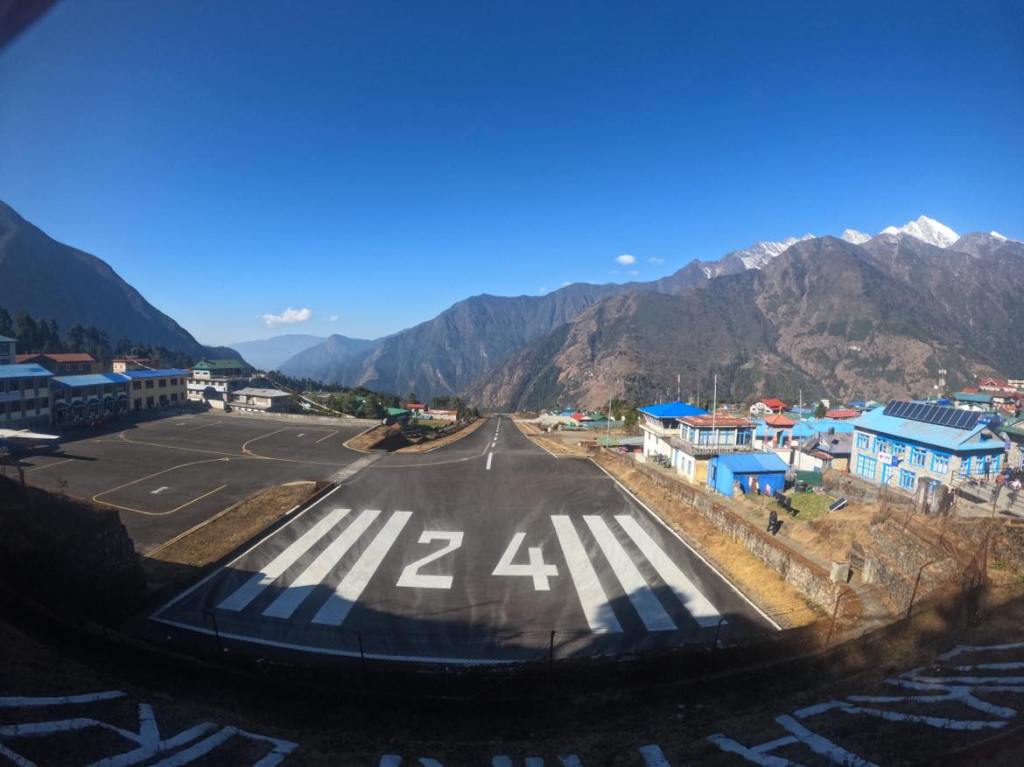
Over its 60-year history, Lukla Airport has taken over 50 lives. Now, that may not seem a lot, but I did the math (yes, I’m a nerd) and this gave us approximately a 1 in 10,000 chance of survival.
There are approximately 1,000 flights per year, the average plane may take 10 people, over 60 years, that’s what my numbers gave me. Now, I don’t know about you, but they seem like pretty short odds when you’re gambling with your life.
A few weeks out from the Trek, Pat and I decided that this flight wasn’t a gamble we wanted to take, so we opted to get a heli into Lukla and then we’d grab the plane for the way out. We convinced ourselves that the heli would be a better experience anyway, but we couldn’t hide from the fact we were shittin’ bricks.
Well, our plan backfired the day before the hike when we questioned the guide about the heli flight. Turns out our change hadn’t been communicated to the team in Kathmandu, so, we were either taking the plane or not going at all. Awesome.
Luckily for us, we couldn’t have picked a better day to fly, which takes most of the risk out of the landing. Most of it. We just had to hope our pilot hadn’t gone out for a bender the night before…
Before we knew it, we were airborne and en route to Lukla. There were some nerves in the air, but our guide, Laxman, had reassured us that regulations and safety protocols had drastically changed over the past few years. He had taken this flight hundreds of times, and he was as cool as they come, so that helped us a lot. With the new regulations, a pilot had to undertake 100 short runway landings and fly in and out of Lukla at least 10 times to become a commercial pilot.
I had read that sitting on the left side of the plane meant you had the best views, so I had parked myself two seats from the cockpit and was lucky enough to snag a seat on the left. As the sun came up, we soared through the air without a moment of turbulence. To see the endless, monstrous mountain ranges for the first time literally takes your breath away. Peak after peak soaring above 5,000 m. These make Mount Dandenong back home look like a speed bump.
The awe of everything had calmed my nerves a little, and before we knew it, we were starting our descent. I’ve sat in a small propeller plane a few times and it always calms me when I can see the pilots and you’re reminded that this is their job, they do this every day. I could see them running through the pre-landing checklist and they seemed as cool as ever. Meanwhile Pat and I nervously looked at each other as if to say; well, this is it.
It’s surreal when you first see the landing. The plane is literally dodging mountains and weaving through the valleys to line up to the most absurd runway you’ve ever seen. Far too short, too narrow and with far too many immovable hills surrounding it. It was surprisingly comforting seeing the runway because you could get a sense that everything was going to plan and we felt as though we were lining things up quite well, not that I would know if we were coming in too low or high anyway. Before we knew it, before we could really shit ourselves, the landing came up on us and the wheels touched the ground. The plane almost immediately started to roar, which we figured was the pilots breaking the engines so that we didn’t collide with the rock wall at the end of the runway. There were a few cheers and you could instantly feel the tense energy in the plane drop. I hadn’t felt a sense of adrenaline and relief like that in a long time.


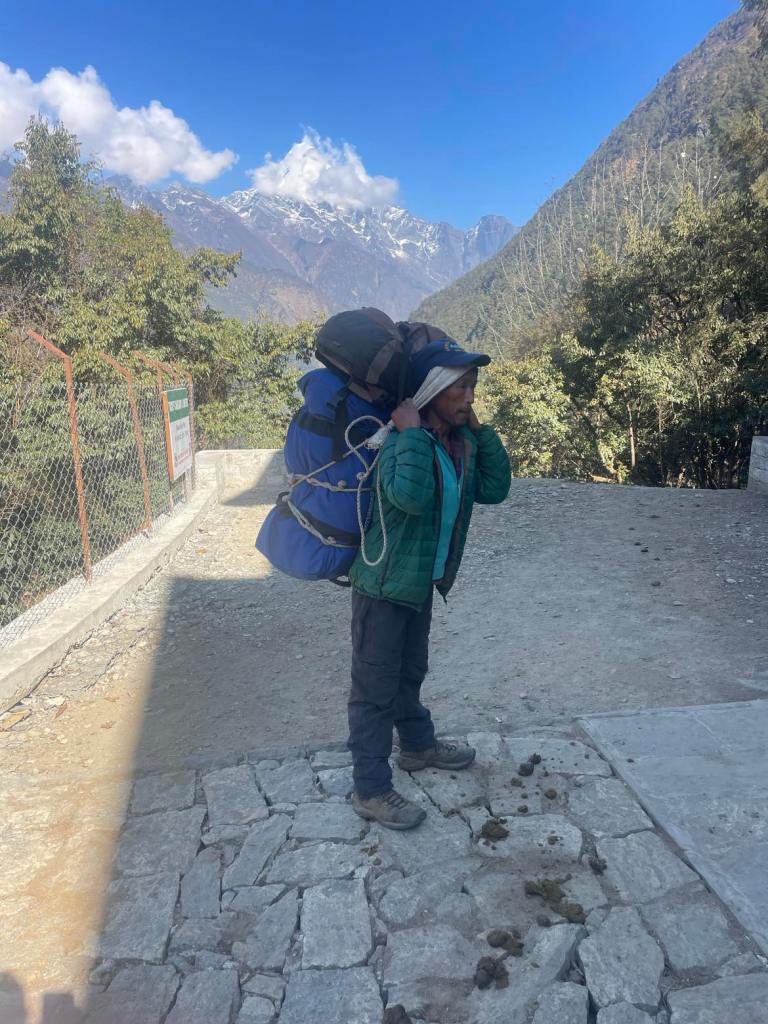
After being quickly ferried through the ‘airport’ (a small pink room), we were introduced to our local porter, who stood a mere 5’5 or so tall and would have been lucky to have weighed 60kg. He didn’t speak a word of English, but he had a smile that told us he was happy to be on his first hike of the season. I felt a little guilty about this man carrying our bags all the way up and down the mountain for us. He would carry both bags as well as his own gear, all amounting to 25-30kg. As you can see from the picture, the Nepalese have discovered that transferring the weight through the head makes it much easier to carry and means they can carry ludicrous weights on there back. For me, it just didn’t feel right, knowing that I could carry my 15kg or so up the mountain. But, Laxman assured as that we had done the right thing, for this is how the porter survived and supported his family.

Our first day took us into the little village of Phakding, a short and relatively easy 6km hike from Lukla with similar elevation. Pat and I were under the impression that we would be hiking with a group, however, it turned out it would just be us two and our guide. For us, this turned out to be a positive. It meant that we could move at our own pace, stop when we wanted to stop, and we also got a wealth of knowledge from the legendary Laxman. From day 1, we were learning about the local people, their culture, language and what the mountains meant to them. Having a guide that was born and raised in Lukla was great and gave us the confidence that we needed. We would still get the chance to meet different people and groups along the way, but we had our independence when we were hiking which was fortunate.
We arrived in Pkakding around lunchtime and tucked into our first Dal Bhat, the infamous Nepalese dish that was consumed all too often by the locals. Pat and I can both demolish a meal, so within a few minutes, our plates were empty. The mistake we made was ordering an entrée for our Dal Bhat and then having the chef come and fill out plates back up once our meal was finished. Turns out you can reorder a plate of Dal as many times as you want. Well, we took them up on this and crawled out of the little tea house about 30 minutes later, barely able to walk.
Pat and I were ears to the wall when it came to preventing AMS, a condition that will affect nearly anyone once you start climbing above 3000 m. If we weren’t careful, we would be evacuated from the mountain before we even got a glimpse of the big girl, so we did everything we could to prevent this from happening. This was the advice we received;
- Drink as much water as possible. Ideally 4-5 litres per day. Your body must work so much harder at altitude, when you sleep and when you hike, therefore your body is constantly needing to be topped up.
- Same goes with food. People often lost 5-10% of their body weight on these hikes, weight both Pat and I did not have to lose so force-feeding was a necessity.
- Take your ego out of it. It’s not a race. There are plenty of ‘fit’ people that still get AMS because they don’t listen to the advice of the guide. We weren’t going to be those guys.
- Control your breathing as often as possible. When you’re gassed, stop, take 5-10 big deep breaths into the belly and exhale. Panting or short breaths were the enemies.
- Take Diamox. Period. There are no downsides, so again, lose the ego.
- On the acclimatisation days, if you had the energy, climb high and sleep low. This meant trying to reach as high of an altitude as you could without burning yourself out to give yourself the best chance to acclimatise.
Well, I think I took the force-feeding a little too far on the first day. After hopping into bed around 9:00 PM, I was playing tug-of-war with myself, trying to convince myself I didn’t have an upset stomach. I had devoured far too much food, food I hadn’t eaten before and it was not agreeing with me. This was not when you wanted to get sick or have food poisoning. 2 hours later, I lost the wrestle and b-lined for the bathroom. Projectile would be an understatement; this nearly made a dent in the toilet bowl. It was clear by this point that this Dal wanted to escape, and we would continue a tug-of-war for the next 5-6 hours. Alas, by around 5 AM, the wrestling match ended. Dal Bhat 4, Jackson 0.
After barely having slept a wink, we were onwards and upwards to Namche Bazaar, which was one of the more difficult days in terms of elevation climbed. Phakding sits at around 2600 m, Namche at 3450 m. This day would result in around 11km hiked and over 1000m of total elevation climbed. Lucky for me, the sheer beauty of the mountains kept me from thinking about my restless night and my sense of awe gave me some much-needed energy. As we climbed, the air got noticeably thinner, and the boys quietened. My eventful night quickly caught up to me and I battled through the last few hours of the day. Thankfully Pat and Laxman were both feeling strong, so they pulled me along.
The following day would turn out to be one of my favourites. As it was an acclimatisation day, we would sleep another night at Namche but hike up to the Everest View Hotel, which sat at circa 4,000 m. This was our first glimpse at Everest. To be honest, seeing her was a little underwhelming. Although I had read this, Everest is largely blocked by neighbouring mountains Lhotse & Nuptse. However, everything else in my view was anything but underwhelming. I find it funny that humans get so caught up in seeing the biggest that we forget the beauty of everything else. Even the mountains that were dwarfed by Everest at a measly 5,000 m were astonishing. This was also the day I laid eyes on the most beautiful bit of nature I think I had ever seen, Ama Dablam. It is impossible to verbalise how stunning this mountain is. Perhaps because she sits on her own and her peaks are fierce, jagged, and extremely steep. Much fewer people have attempted to climb this mountain and for good reason. The photos I took on this day are up there with my favourite of the whole trip. We were far enough away from the 8,000m+ peaks that it was possible to get a reasonable scale of their enormity but also close enough to some of the ‘lesser’ mountains to really appreciate the overall beauty of where we lucky enough to be.
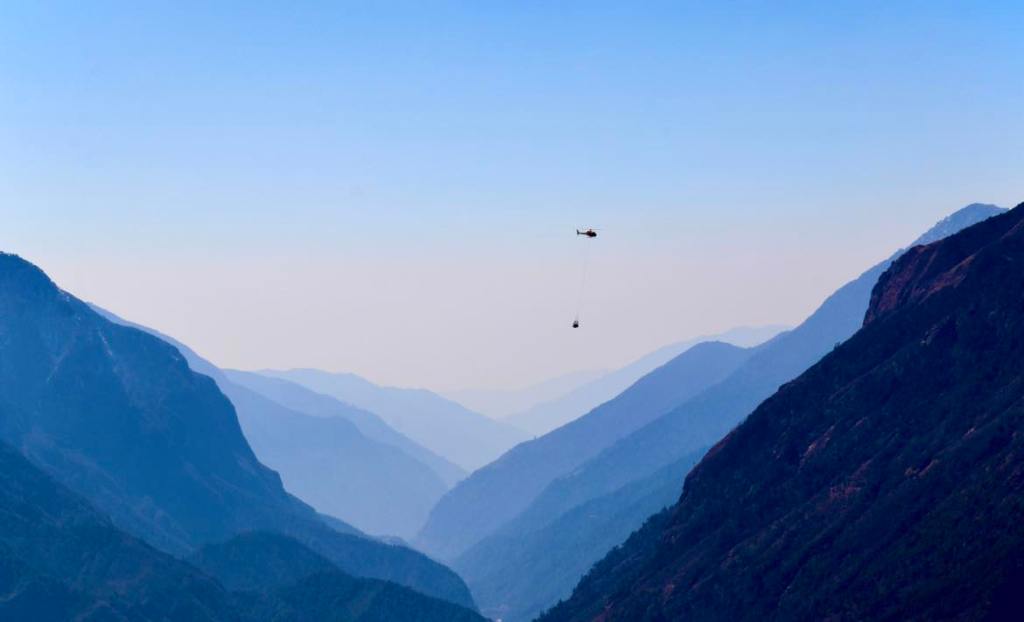
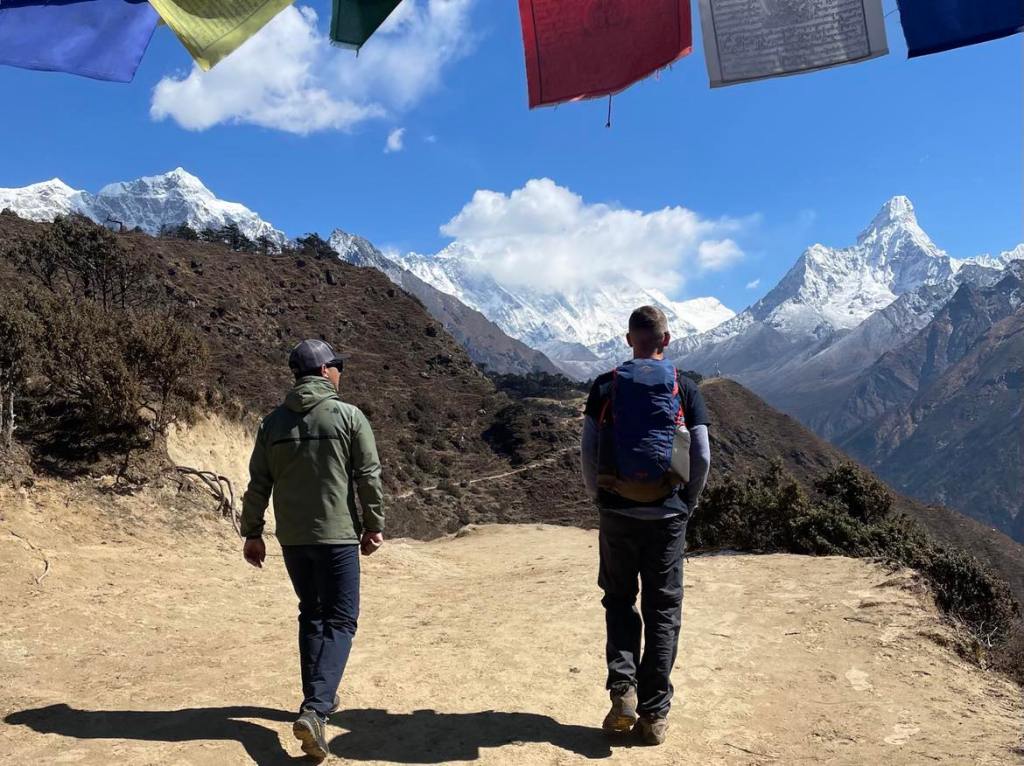

The following few days would see us climb from Namche, stopping at Deboche (3,820m) and continuing onwards to Dingboche (4,410m). It was on these days that we really saw our environment change. Above 4,000 m, the trees don’t have enough oxygen to survive, the nights were hovering around -12 and every inclined step was not without effort. Dingboche was our final acclimatisation day and would see us join the 5,000 m club. From the tea house to our destination was ~2km in distance but would require us to climb 600-700m vertically. No easy feat. We were lucky enough that the previous night had a deluge of snow but when morning came around, it was a bluebird. This meant that all of the mountains and the village were completely whited-out, leaving us with an astonishing view. We couldn’t see Everest anymore but we were on the foothills of Ama Dablam and had the valley back to Namche right in front of us. I won’t even try to explain this, rather I will drop some photos below and let you try and use your own words to describe what I was seeing, because I can’t find them.

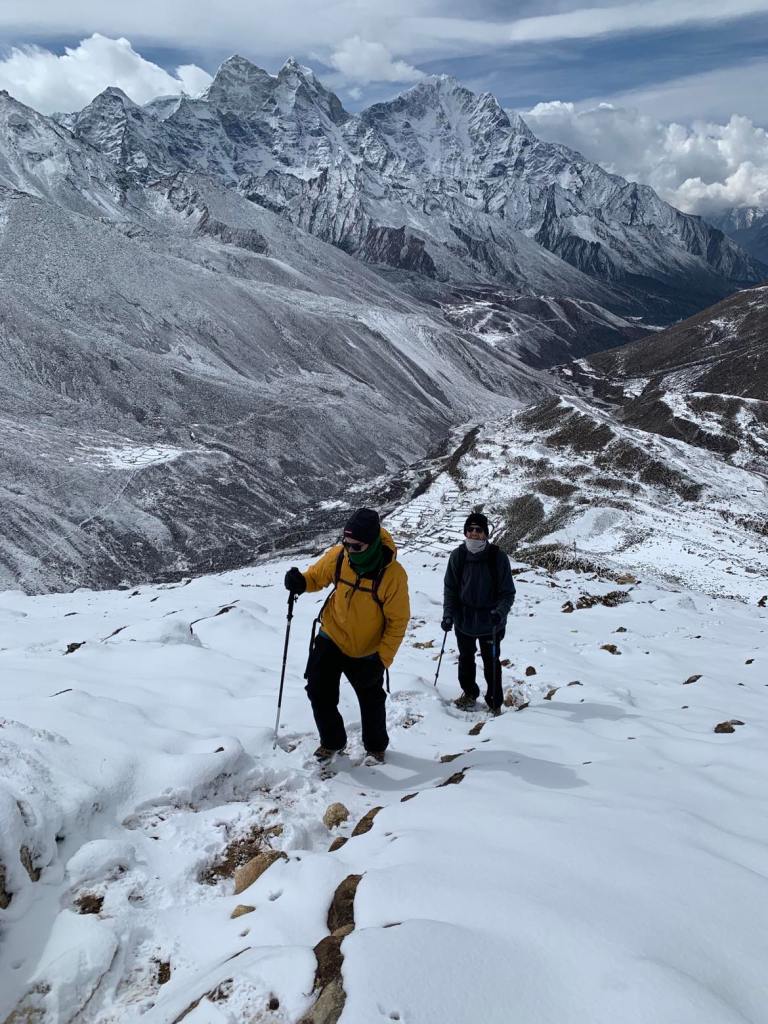

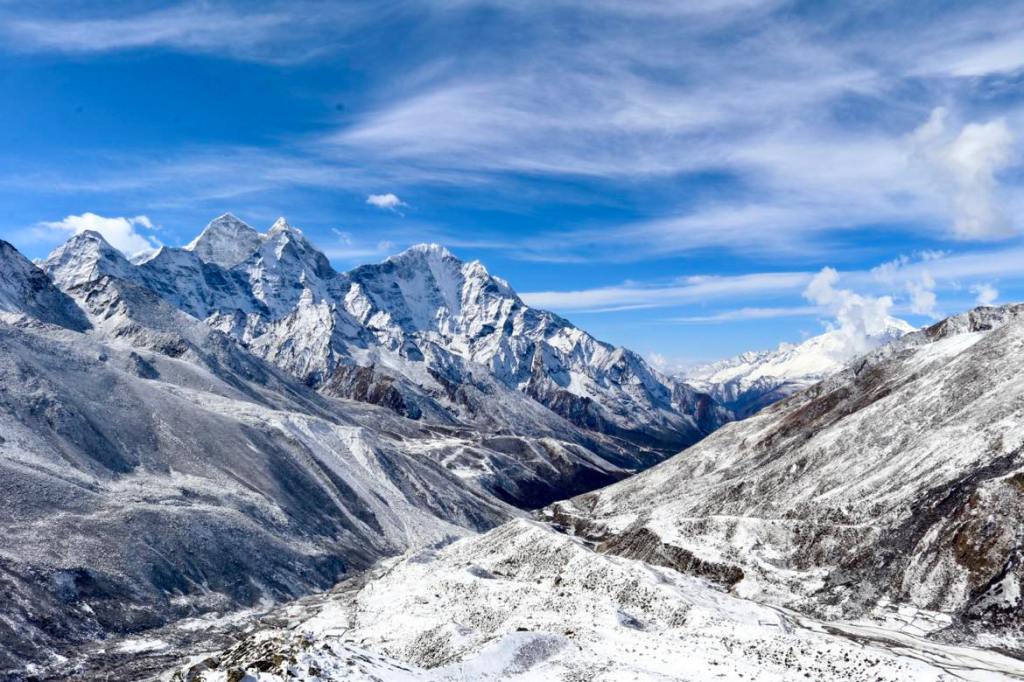
By this point, around day 7, Pat and I were feeling surprisingly strong. We both had managed some minor stomach upsets and were starting to lose our appetite a little, but all in all, we were both feeling good. Our diets consisted mainly of eggs in the morning, fried rice for lunch, and a very rudimentary cheese and tomato pizza by night. My encounter with the Dal Bhat had left me with an avoidance of the local dish, so I mostly stayed clear of this whilst at altitude. Oh and of course, a daily snickers bar. These were our saving grace when we were starting to struggle in the afternoons or just needed a sugar hit, these, and the odd coca cola. Trust me, you really start to appreciate the little things when you’re at altitude and freezing your knackers off.
From Dingboche, our hike continued towards Labuche (4,940m), where we would have our final rest before making the push for Everest Base Camp (5,364 m). By now, the water in the toilet bowl was starting to freeze and you could forget about having a shower. A warm cup of tea/coffee before and after each day was a Godsend, doing its best to warm us up from the inside.
The morning we woke up for our EBC push we were welcomed with another white-out, except this time we weren’t blessed with a bluebird, rather we could barely see anything. There was an element of disappointment in the air that we may not get to fully experience base camp but we remained optimistic that things would clear up. On the way up, we spun every Buddhist wheel clockwise, walked to the left of every monument and visited the local monastery to try and keep luck on our side. I’m usually not a superstitious person but there was no way I was taking my chances up there, plus it was nice to learn and partake in some of the Buddhist rituals.
The trek up would last for 4-5 hours, with a quick stop at Garapshe to refuel. We were making good time and an early start meant we were on track to get to base camp before midday, a definite win with the weather around. Luckily, mother nature decided to bless us and when we were 30 minutes from base camp, the skies began to clear. Once again, no words do this moment any justice. We had a complete view of the Khumbu icefall, Pumori and could see Everest’s glorious summit. There were a few tents pitched at base camp, getting ready for their 6–8-week expedition to summit Everest, but other than this, it was freakishly earie. When we had stopped for a quick rest, we heard a deep and distant rumble that immediately silenced everyone. Pat and I anxiously looked at Laxman, to which he calmly replied; ‘Avalanche’, as if it were an everyday occurrence. This served as a reminder as to just how remote we were and that we were at the complete mercy of mother nature.
We arrived at base camp just after 11 AM, with only a handful of other people around. Pat, Lax and I embraced, all sharing a similar expression of relief and excitement. We had done it. We grabbed a couple of photos in front of the famous spray-painted rock, had a quick look around and then all agreed that it was best we make our way back down. By the time we had gotten on the move, the weather had begun to turn and we were reminded just how lucky we were. The skies opened that day for barely an hour, the hour we got to base camp.

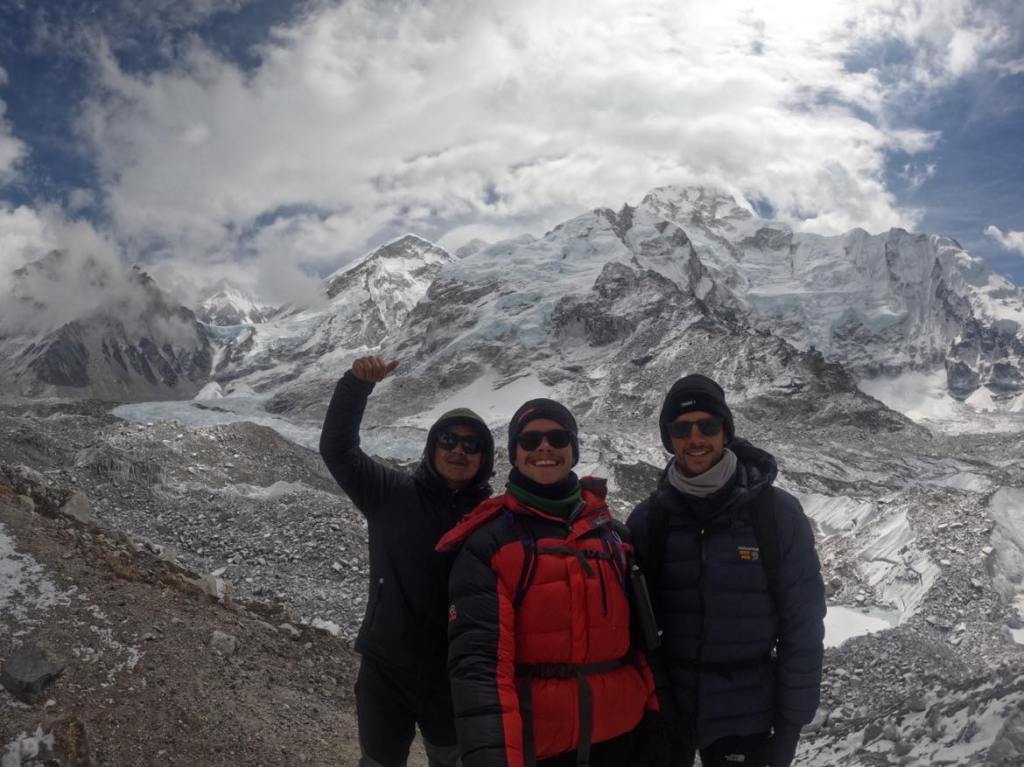
By the time we got back to Garapshe, I could feel the effects of the altitude. I had a bad headache and didn’t feel like eating too much. I took a couple of Neurofen, made sure to drink a mountain of water and did my best to down some food. Within a couple of hours, I was back to feeling relatively normal, although still freezing and exhausted.
For many, this would be the end of their ascent and the following day would see them b-line for Lukla and return down the mountain in as little as 4 or 5 days. For Pat and I, we had, perhaps naively, planned to continue for another 5 days at +5,000m, with Kala Patthar (5,644m), Cho La Pass (5,420) and the Gokyo region (~5,300) still ahead of us.
After a rather restless night’s sleep, we woke up at 4:45 AM to summit Kala Patthar, in temperatures that were -20 and below. It’s fair to say we weren’t that excited. As it had snowed all night again, we nearly pulled the pin that morning because we were sure visibility would be poor, after all we couldn’t see the stars or the moon. However, Laxman convinced us that it might be worth it, so we pushed on. This morning was one of the hardest yet; it was cold beyond belief, we were convinced the hike would be for nothing and it was 5AM, the morning after we had just been to base camp. We were buggered.
Well, I don’t think I’ve ever been more wrong about anything in my life. Once we had climbed for 30 minutes, we got above a layer of fog that had quite literally clouded our judgment. The views were, once again, other-worldly. Pat and I strangely found another gear when we were about halfway up and started to really push on. It was ridiculously cold, so the less time we spent on the mountain the better. After 2 hours, we reached the summit of Kala Patthar and were mind blown with what we were seeing. We had the best view of Everest yet and were utterly surrounded by the Might of the Himalayas. This would end up being the absolute highlight of the trip, with footage caught on the GoPro later reminding me just how ridiculous this morning was. We got down the summit in just over an hour and once again found ourselves hugging a cup of warm tea, on a high by what we had just experienced.
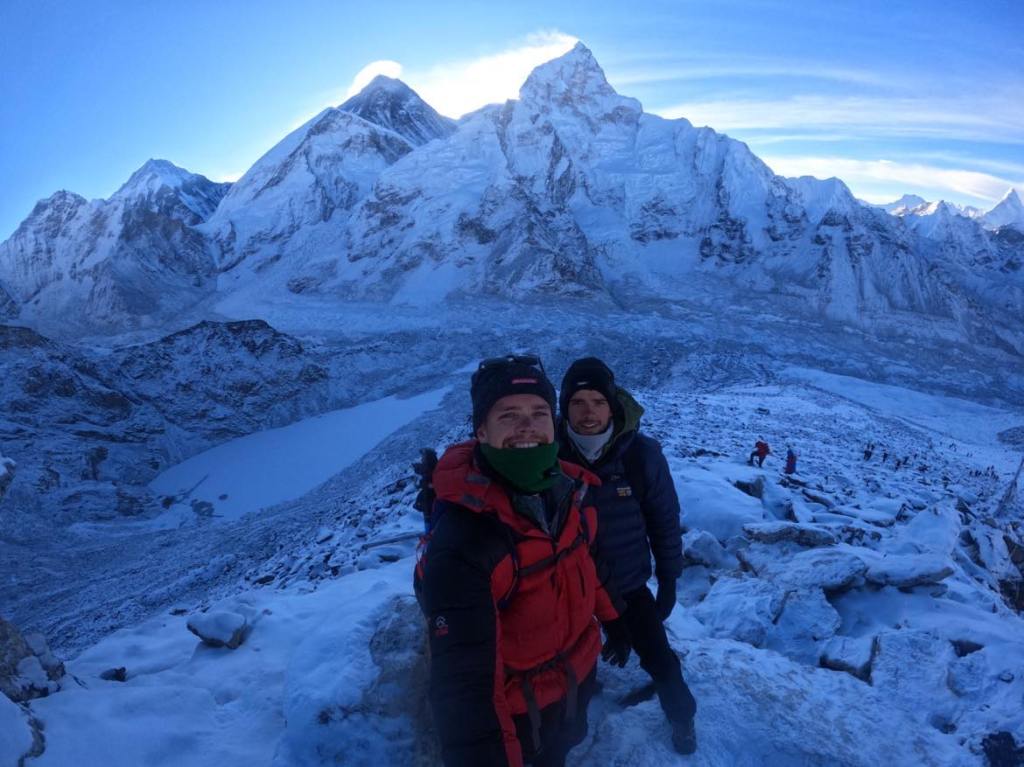
This incredible summit would turn out to be the last milestone of our trek. From this point onwards, the weather really started to turn. By the time we made it to Dzongla, our pit-stop before attempting to traverse the Cho La pass, it was heavily snowing and the forecast was showing that the next 3-4 days would see 50-100 cm of snow. This was extremely rare for this time of the year.
After long discussions with Pat, we both decided we weren’t comfortable taking the risk over Cho La. We had chatted to a few hikers who had come from the other way and they were all surprised by just how sketchy and threatening the pass was. They reminded us that one wrong step and that was it. The end. Without crampons, proper snow gear or much experience mountaineering, we decided we were well and truly out of our depth and pulled the pin. To be honest, we mainly just felt a sense of relief. Kalar Patthar had delivered everything we had dreamed of and we were proud of our achievements thus far. It was time to swallow our pride and make the smart choice, a choice I’m sure our family and friends would have welcomed. You can’t always catch the biggest fish.


We made our way down the mountain over the next 5 days and felt we had made the right choice. Visibility was non-existent and the snow was relentless. We enjoyed a few too many beers at Namche, a tale for another day, but let’s just say I temporarily lost my jacket, wallet and found myself in another room other than my own because I had also lost my key. All items were, thankfully, later found. Turns out us Aussies can get a little too carried away, even at the highest Irish Pub in the world.
Two days later we found ourselves flying back to Kathmandu, still shitting ourselves with what would be a rather sketchy plane trip. Our flight was delayed by 3 hours or so and we ended up being one of the last flights for that day before the weather became too poor to fly. There wasn’t a moment the whole return flight that we didn’t experience turbulence, so let’s just say that when the wheels touched down in Kathmandu, we were relieved.
This trip will be remembered for a lifetime and Nepal will be a place I return to. It was awesome to have shared this with such a close mate and no doubt this trip will be something we chew the fat over for years to come. If you like a little adventure and appreciate nature, I cannot recommend this trip high enough. Yes, there are some sketchy moments, but it is more worth it than I can possibly describe here. A huge thank you to our guide, Laxman and our porter. You both made this trip exceptional; we could not be more grateful.
Nepal, see you soon.
 Jackson Farley Blog